
I was a pi child. I was raised Catholic, and even though I found mass extremely dull, nonetheless I read the bible and learned my hymns and some catechism and was of the strong and widely-shared belief that families who went to mass were fundamentally better than those who did not, an unhelpful input for any child.
I kept it going for a long time too, I was still attending mass as a postgraduate. Until I just couldn’t. Not that I chose not to, or turned away from God or anything like that. I just simply couldn’t believe in it at all, any more than I believe in any of the other religions, or a lot of what passes for secular piety in our age. I don’t believe in much.1
Now I am older and the world grows more atomised, the binding together of small, welcoming, closeknit, charitable communities right across the world makes an awful lot of sense to an awful lot of people, even I suppose if you factor in the cost to women, gay people and small children- and I always try and respect other peoples’ (except that foul Maga/ Evangelical fusion abomination).
I am also aware that my own deep beliefs in feminism and democracy are considered niche, wacky and temporary by the majority of humans on this earth.
Regardless, my favourite composer was the nun Estelle White, famous for I Saw the Grass (total banger), Make Me a Channel of Your Peace (likewise) and Oh the Love of my Lord is the Essence (choon). I still have an ambition to write a fringe musical based on her life with singalong hymns- she left the convent and spent the rest of her life living lovingly with another woman- and even wrote to her estate about the rights but never heard back. I wonder if the Vatican hold the rights, and how up they are for my banging gay nunsical. People LOVE nunsicals. I digress.
One of my brothers also stood up at my wedding and, as a surprise, read out an essay I wrote aged around 8 my mum had kept entitled When I Grow Up. I was going to be a nun, then write at night to support the convent. I think a 50% success prediction rate at age 8 is pretty good going thank you very much.
All this to say, I am very very relieved I didn’t read this book back then. I might well have gone. I remember vividly the thrill when our teachers (they were all basically religious ed teachers) explained to us in primary school that if we had a vocation and ignored it, we could never be happy!!!!
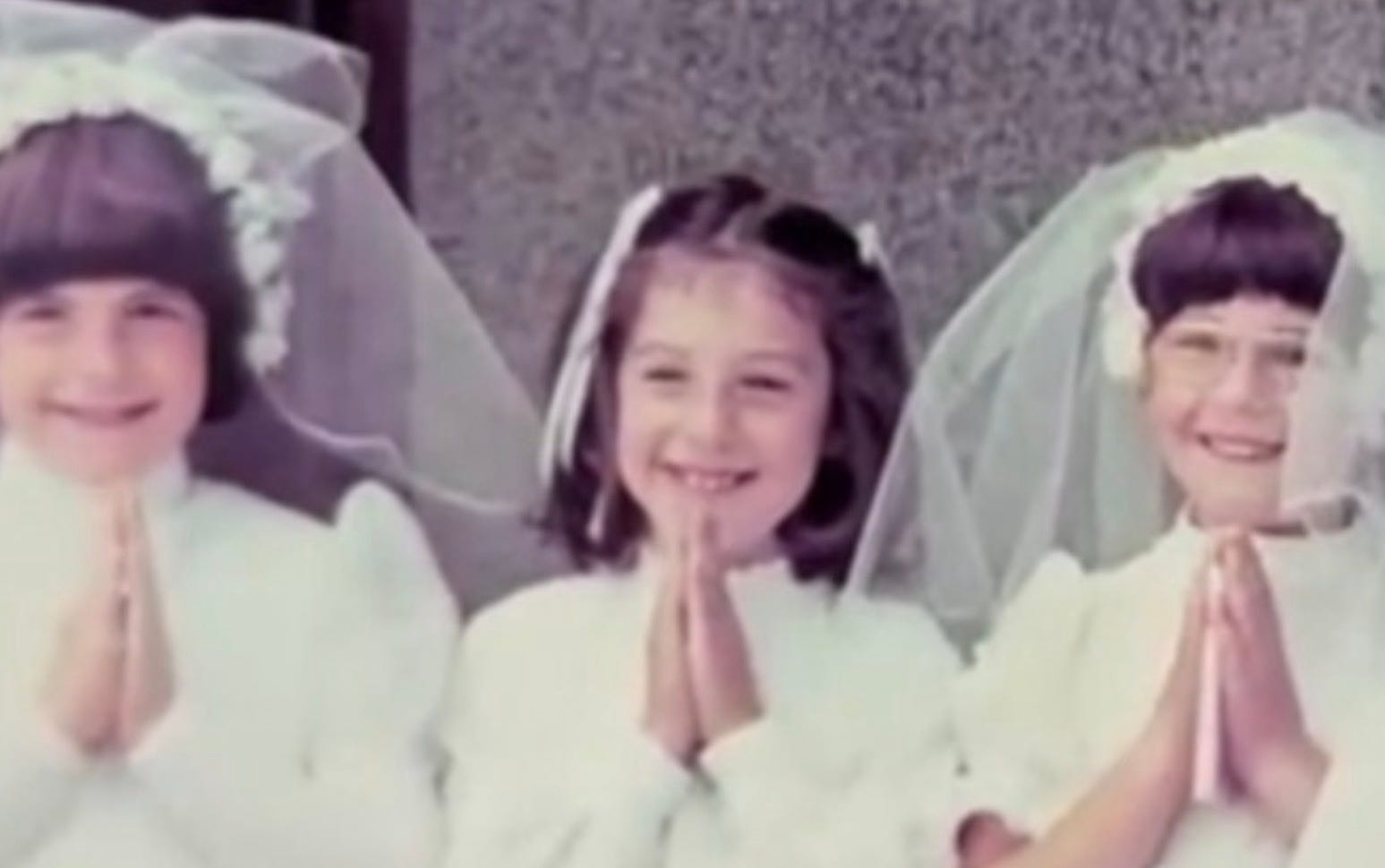
I was the only girl in my class without a veil by the way, my mum thought they were naff and she was making my outfit. Judi Taylor had a MUFF. I was furious about it (sin: anger, class: venial), which at least meant I was unlikely to end up like my nemesis the Blessed Imelda, whom God took when she was taking her First Communion because He loved her so much and she was so perfect, ie she FELL DOWN DEAD IN THIS STORY WE ARE TELLING SIX YEAR OLDS. No wonder there are so many Catholic novelists, I swear to God.
Anyway, In This House of Brede by Rumer Godden is one of the Virago reprints, which I absolutely approve of- they reprint old brilliant books you might not have seen otherwise- whilst also being a bit like, ‘hang on! Some of us are still alive buy ours instead!’ but that is a classic writer sentiment (sin: envy, class: venial).
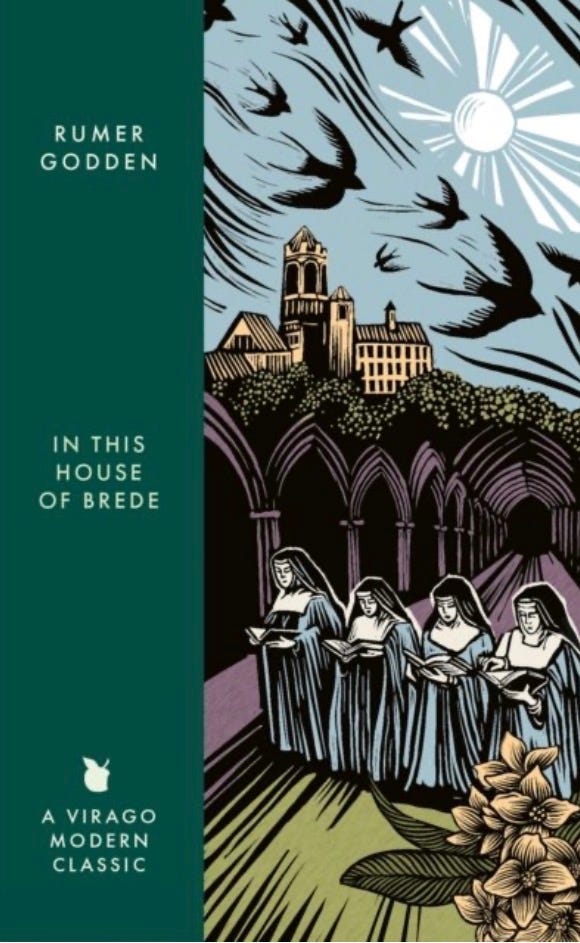
It it hard to describe a book about the comings and goings of an enclosed order as thrilling, but it absolutely is. It is incredibly exciting to walk the cloisters with these women. The characters pulse with life and urgency, and made me remember with some rue an argument my mother and I had had where I talked about wasted lives in nunneries and she pointed out what good lives they were, often, particularly compared with what else was on offer for women.
But the moments where Phillipa, the brilliant career woman, realises she will never again see the sea, or take a hot bath, or we get an insight into the first night of a closed order, and how much you will cry, are so vividly drawn. This book is genuinely amazing; a full slice of life for you to experience. My friend’s aunt was in an enclosed order, and they visited her once a year at Christmas and spoke to her behind a grille, and I found this concept deeply terrifying.
The book was written in the 1950s, just as the world was about to change, but it hadn’t changed yet, and Godden manages to snatch it just in time and preserve it for us. The adoration the young nuns pour into the kittens and chickens under the care is particularly sad; the idea of a life that was self-sacrificing on purpose but brought its own satisfactions thoroughly fascinating when you consider the mental miseries abundance has brought so many of us. It is purest anthropology and I am obsessed with it: that in a mild corner of England, within living memory, for the price of a pint- you can travel to the very extreme ends of human experience.
Author humiliation of the week
Me on very important foreign zoom call: oh yes the book is to stand up for 55 year old women like me
Terrifyingly glam foreign publisher being polite: oh what’s your skincare secret?
Me: I’ve got the filter on!
Everyone: silence
Love,
Jen xxxxx
ghosts no ouiji no heaven and hell no existence of a being that is perfect but also hates gays and lets children die of treatable diseases no crystals no homeopathy no Q anon no vampires no zombies no aliens durr yes that’s just arithmetic.