Despattches

I am not a ‘Completer- Finisher’, if people still use that term. I last had an office job in the twentieth century, when Myers-Briggs was a thing. I don’t know if it is still a thing, but the office I worked in used to train Myers-Briggs examiners, and they used to practice on me, so I took it about a gajillion times. I would do my best to mess with it, but it always came out the same, so I can confirm that even if it is total bollocks, it is extremely consistent bollocks1.
Anyway this is by way of explaining that because of my general lack of attention to detail, I commonly have trouble differentiating Ann(e)s Tyler and Patchett.
It’s easy with the Naomis, there’s the useful rhyme (’Naomi Klein you’re fine, Naomi Woolf, OOF!”), but the Ann(e)s are harder, particularly since Patchett’s last two novels have been quieter, more domestic family affairs than, eg, Bel Canto.
Some male critics have complained that her latest, Whistler is too gentle and sentimental. Friends, enough with these moronic boys. Unless there’s a male character looking tortured into the distance of a war-torn mittel european landscape/ the deep reaches of space and a female character saying, ‘don’t go out there Piotr/ Jack, it’s too liminal/ dangerous!!’, they cannot be happy.
Whistler is instead an extraordinary achievement; to bring a small story home about memory and family, and to make everyone decent, more or less (although there is a poison pen sketch of an unpleasant woman done so finely it’s like a Tracey Emin drawing).
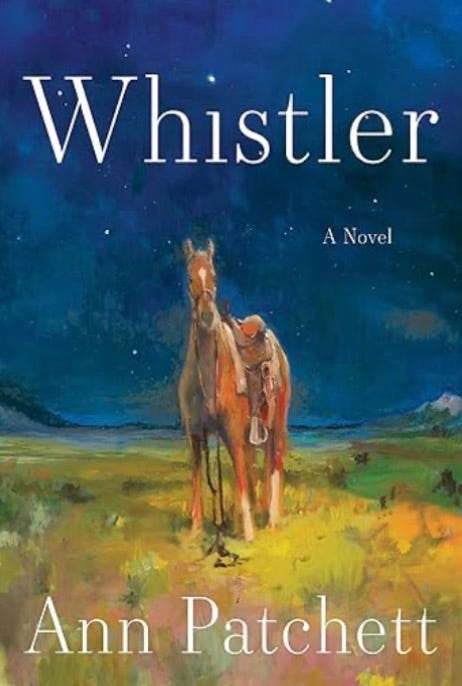
It is utterly wonderful on childhood and memory and pain and what makes a good life and middle and old age- there’s a hilarious section where a character realises her stepfather’s ridiculous series of books about POSITIVITY! she and her sister have spent a lifetime taking the piss out of actually contain lots of useful stuff- and it is gently, properly, heartbreakingly adorable and you will love it. Don’t read any deeper reviews than this, they will spoil all the gentle surprises that await you, popping off like tiny fireworks.
Interestingly, it also does something that’s really hard to do: it has something creative embedded inside the narrative that actually works. I remember when Aaron Sorkin made Studio 60 on the Sunset Strip at the same time as Tina Fey made 30 Rock. Studio 60’s HUGE mistake was showing the (not very amusing) sketches. Fey never does, you just see Tracey coming off stage in a werewolf costume, or sixteen gogo girls running past dressed as frogs or whatever. 30 Rock ran for years, whereas 2Studio 60 was cancelled immediately.
It’s incredibly hard to write about a piece of creative work, then write it well enough to live up to its billing. I was the solitary soul who didn’t like AS Byatt’s Possession, but she sure got the super-boring poetry right. John Irving’s A Widow for One Year pulls it off too, with A Sound Like Someone Trying Not to Make a Sound- oh what a genius he was in his pomp. Also Pop Goes My Heart in the impeccable Music & Lyrics does actually pass muster as an 80s hit you could live off.
I have never had the nerve to finish mine. If you read me, you’ll know there is a common thread of a missing book, called Up on the Rooftops. It often appears in passing, occasionally as a deux ex machina.
There is a reason for this. In 2012, the summer of the Olympics, my husband was at sea, and I was in London with our children, then aged 3, 5 and 7. Our flat on Fleet Street had a fire escape that led out of the bathroom up to the roof, from which the children were barred on pain of entirely possible death, so of course they were constantly trying to shin up it.

I dreamed up a story of three children, Wallace, Michael-Francis and Delphine, escaping to the roof, and losing Delphine to the Queen of the Nethers; the boys then having to get across London to Galleon’s Reach without their feet touching the ground, aided by a one-legged junk-food addicted pigeon called Robert Carrier.
I wrote three chapters, and my then agent told me there was no market for that kind of thing, so I stopped. Those three chapters contain the best, clearest picture of my children at that age I have. No photo or video comes anywhere close. My dearest regret in this life is not finishing it; published or not, I would have had a total record of them at those glorious ages, and how they all spoke and behaved and interacted with one another- and, I suppose, how I spoke to them, although I did not appear very much, parents only ever being a hindrance in children’s literature.
Well, I did not, and could not now, but it haunts all my stories. We get asked a lot if it is real, and quite often people bookleg some shit together with that title and throw it up on Amazon to try and fool people, and we have to get it taken down.
Anyway, in this book the nested story, about Mary and Whistler the horse, is beautiful, and works perfectly.
I have also learned how to resolve the Patchett/ Tyler situation. When it comes to families, her solution is never to tear everything up, or start over, but to patch it: to stitch up and mend as many relationships as you can, as well as you can, in the time you have left in this life, knowing nothing can ever perfect, but that make do and mend is not the worst advice. She is nominative determinism in action.
As for the equally excellent Tyler, her books are always set in BalTimore.
Author Humiliation of the week:
Woman on a barge trip where the chef was good: You’re in publishing aren’t you? Can you get the chef to write a cook book and get it published?
Me: Uhm that’s not really how it works.
Woman: but he’s very good. We all told him he should publish a cookbook.
Me: Yeah but...
Woman stomps off crossly, next seen very obviously telling her friends I am viciously gatekeeping the lucrative Flanders bicycle barge chef cookbook market.
Love,
Jen xxxx
I recall I am ENFP, which I cannot be arsed to look up, but reliably has extrovert in there.
this was extremely disappointing to me as the idea of having my two great 90s crushes, Chandler and Josh, in the same TV show, was almost unbearably exciting, and could only have been bettered by Fox Mulder showing up.